
 Google Chrome
 Safari
 Firefox
 Edge
Edge
The 9ºW Program
Hovione’s 9ºW Program awards five million euros for three academic projects over three years.
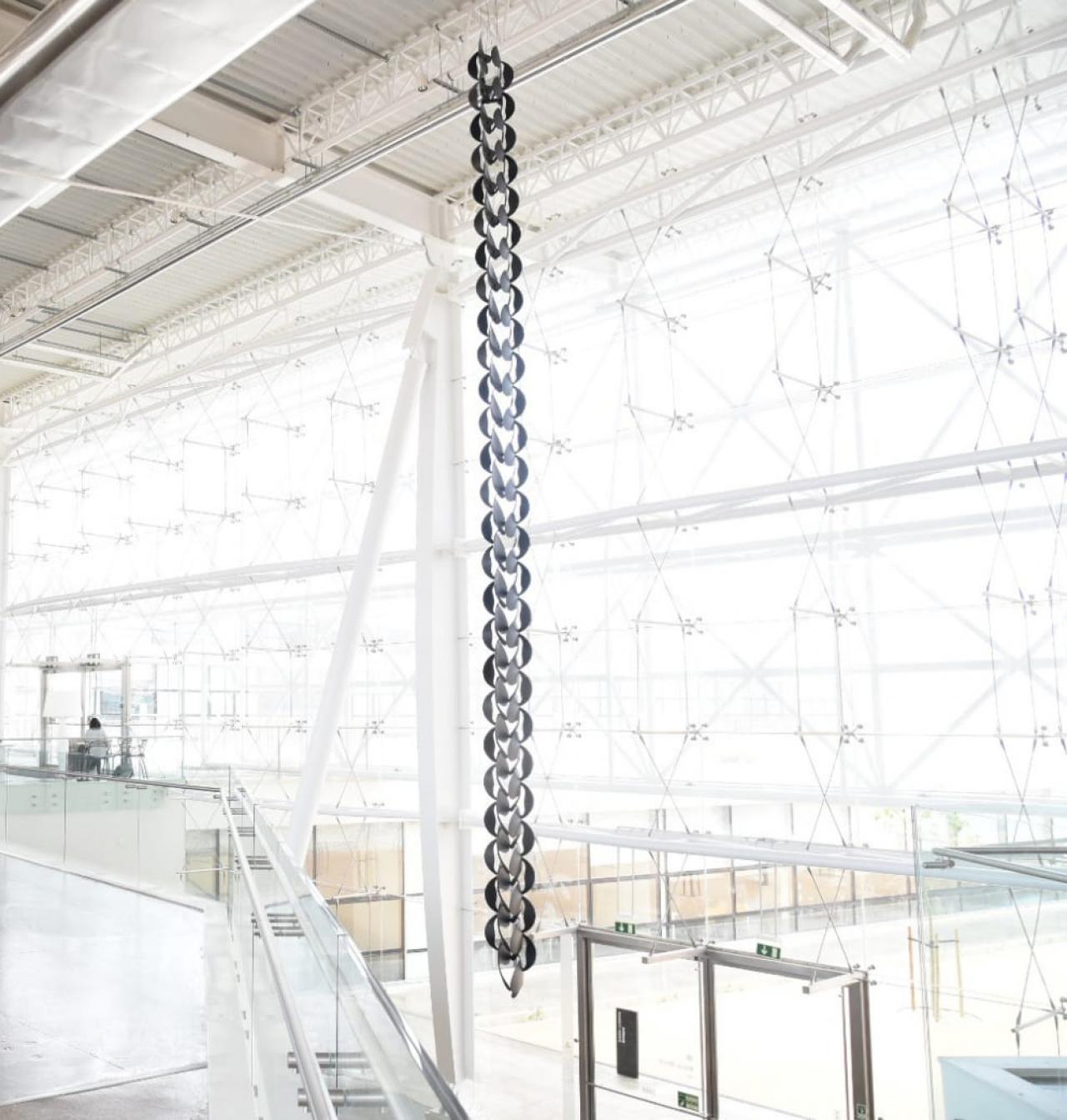
To mark Hovione’s 60th anniversary Hovione commissioned a sculpture from the artist Rui Chafes. On 10th April 2019, Hovione donated the black steel 9m high piece titled ROOT to the NOVA University of Lisbon. Root also stands for 9ºW - Hovione’s partnership with Academia, expanding knowledge.
ROOT
“An idea of continuity, of unstoppable growth, something that is at the core, the genesis of something far greater than what is in front of our eyes. Like the idea of a company that was born from the mind of a man and a woman but now exists thanks to the combined effort of so many different people yet united in the same purpose, all equally important, each in her or his function, like the links of a chain. A root that generates something far greater.”
Rui Chafes, 2019 – steel
The 9oW Program was first launched in 2016 as a €5m three year program to fund collaborative research with Portuguese academia. The goal was to work in partnership with academic institutions to help develop innovative and relevant projects to solve challenges Hovione faced. The spirit of 9ºW is all about expanding knowledge, widening our knowledge base and identifying and developing talent.
9ºW has funded three multi-year specific research and education programs that are listed below. In addition 9ºW also supports the Hovione Research Program. HRP establishes conditions for students of MSc and PhD to perform their research on specific Hovione problems, the work is funded and supported by Hovione and takes place in our labs.
Some of our on-going projects are:
Pharmaceutical Continuous Manufacturing
Continuous manufacturing can provide higher productivity and higher product quality. Hovione is committed to continuous manufacturing and is working with several university groups to develop solutions for specific unit operations.
Intelligent Analytical Laboratories
Analytical chemistry is the fastest growing area of the company. We face an increase in sales volume, in project diversity, in escalating regulatory rigor and complexity and our analytical chemistry labs are increasingly under pressure. In order to plan work and manage samples we are developing a scheduling system that will enable us to manage efficiently over 1000 samples per day.
This project aims at increasing the efficiency of our QC labs by providing:
- Traceability improvement;
- Automatic planning and scheduling with intelligent systems accessing big data;
- Automation of intensive/repetitive work.
Analytical Chemistry Training
In every Hovione location the market for bench analytical chemists is tight.
Current academic programs often lack the funding and the equipment to teach the more relevant analytical techniques and do not include topics such as equipment set up, preventive maintenance and GMP.
In Lisbon Hovione partnered with vocational training colleges to find a solution. We funded a state-of-the-art laboratory at ISEL that now operates to Hovione standards. The lab uses Hovione’s LIMS system, our specs, methods and procedures. The lab supervisors were trained in Hovione’s QC abs. The goal is to create a working environment that mirrors the QC labs that routinely release product to the market and need to meet the strict requirements of the EU’s EMA and the US’s FDA.
The first course started in January 2018 and every 5 months 12 chemical analysts graduate ready for a career in the pharmaceutical industry.
The Hovione Research Program
Hovione's business is, at its core, highly scientific and technological.
The Hovione Research Program (HRP) was created in 2009 to stimulate our R&D scientists and to deepen our know-how in areas of interest. Secondary goals include the widening of our knowledge base, networking with the local academic community and the identification and capture of talent from scholars participating in the program. We continue to encourage that spirit by maintaining strong relationships with our academic colleagues, and by supporting their work through collaboration and funding opportunities. All these activities are governed by confidentiality agreements and specific contract agreements with Universities.
Since 2009 and as at 2019, we have, and are supporting, 22 PhD students. These PhDs take place under two co-supervisors: one is the professor from the university that will award the degree and the other is a Hovione scientist. Since inception 8 of these students have completed their PhD thesis in areas such as Process Chemistry, Drug Product, Analytical Chemistry and Manufacturing and were awarded their doctorate. Three out of the 8 PhD thesis remain closed because of the sensitive information they contain.
Today our strategic areas of research include flow chemistry, spray-drying, dry powder for inhalation, biopharmaceuticals, process development and scale-up, modelling, process analytical technologies and digital transformation (such as artificial intelligence, machine learning and robotics).
Currently, we have 14 PhD thesis ongoing, five of which are planned to conclude by end of 2019. All work (and thesis) is protected and confidential, although in many cases parts of it have, after Hovione review and approval, been published.
We also accept 25 MSc students per year to do their research project for 6 months in our labs.
The universities we work with in the PhD programs are:
From Portugal:
- The Faculty of Pharmacy of the University of Lisbon
- The Faculty of Science and Technology of the New University of Lisbon
- The Instituto Superior Técnico of the University of Lisbon
and the University of Budapest of Technology and Economics, in Hungary.
We are keen to diversify the cultural background of our MSc and PhD students. We believe diversity makes a ground more fertile for innovation.
For more information on HRP please contact 9degreeswest@hovione.com
Why 9oW?
During their heyday Portuguese navigators had discovered, re-discovered and/or perfected just about every navigation technology that was needed. The one missing piece was the ability to measure longitude with accuracy. In 1714 the British government challenged the public to solve the greatest scientific issue of the century – how to determine a ship’s location at sea by knowing its longitude. By Act of Parliament £20,000 was offered to whomever could provide a solution which could find longitude to within half a degree (equivalent to 2 minutes of time). In 1737, John Harrison, a clockmaker with little formal education won the prize through his extraordinary determination and mastery of clock-work, he perfected his marine timekeeper, H4. This enabled ships to take with them a reliable and accurate clock that gave Greenwich Mean Time – by measuring the time difference from the local solar time longitude was determined.
9oW is Lisbon’s longitude. Hovione feels that there is still in our world much to be understood and prizes are a good thing – they motivate and they recognize.
In 2014 the British government re-launched the idea of challenging the public to come forward to solve a key societal issue. They selected antibiotic resistance and have offered £10million. httpss://longitudeprize.org/